The Scarecrow Episode 4 Recap: A Handkerchief, A Caramel, and the Partner He Never Wanted
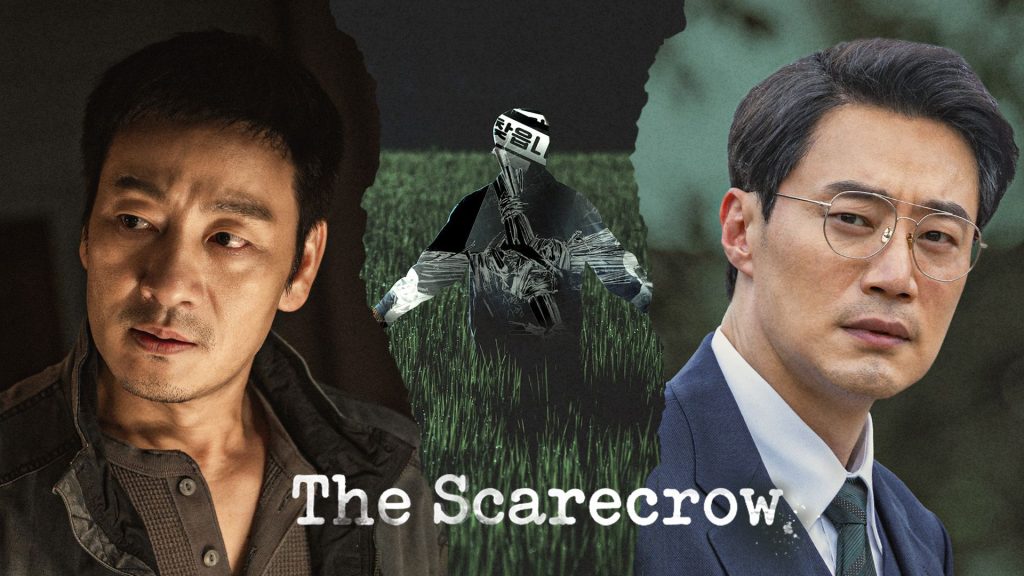 The Scarecrow Episode 4 Recap: “The Things We Cannot Unsee”
Drama: The Scarecrow (허수아비)
Network: ENA
Streaming: Viu & Viki (International)
Air Date: May 5, 2026
Cast: Park Hae-soo, Lee Hee-joon, Kwak Sun-young, Song Geon-hee, Seo Ji-hye, Jung Moon-sung
“It was the bad side. I lost everything.”
— Kang Tae-joo, 2019. Asked what joining forces with the man he hated most had done to his life.
There are partnerships born from trust. And then there are partnerships born from necessity — the kind where two people who would rather do anything else find themselves on the same side of a line because the alternative is watching the wrong things keep winning.
Episode 4 is about that second kind of partnership. It is also about a caramel. And a handkerchief. And thirty years of a misunderstanding so complete it carved itself into two lives and never let go.
A Caramel Is No Longer Just a Caramel
We open in the morgue.
Tae-joo goes directly to the autopsy room before he has fully steadied himself. The medical examiner delivers the findings with clinical detachment, but the details land like physical blows.
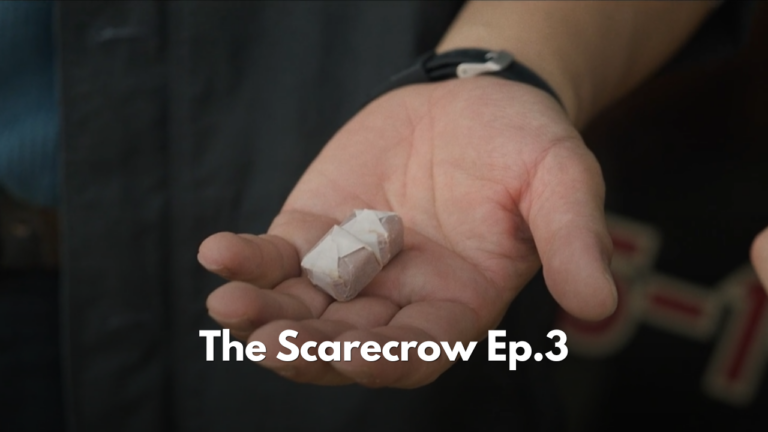
Cause of death: strangulation. The killer has escalated — new, deliberate cruelty added to the signature. And inside the victim’s body, investigators found a caramel.
The same caramel Min-ji had in her pocket. The same caramel she gave to Tae-joo.
In Korean investigative culture, evidence that mirrors the victim’s personal belongings carries a specific, chilling implication: the killer knew her. Not as a random target but as a specific person. He took something that belonged to her world and made it part of his ritual.
The caramel that was a gift between a child and a detective she trusted has become the killer’s calling card. Tae-joo, standing in the autopsy room, knows he will never be able to eat one again.
“I’ll Work With You” — The Words That Cost Everything
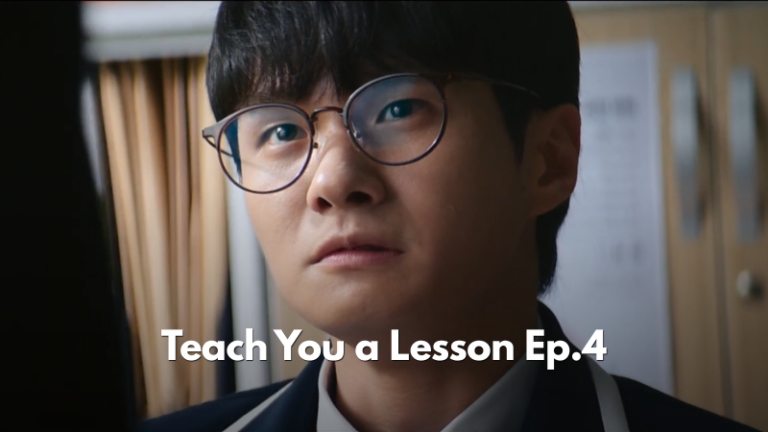
At the crime scene, Cha Si-young (Lee Hee-joon) finds Tae-joo and delivers the expected message: this isn’t your case. You resigned. Walk away.
Tae-joo looks at him for a moment.
“I need to catch him. Work with me.”
For anyone who has watched the previous three episodes — who has seen exactly what Si-young has done to Tae-joo’s family, his career, his sister’s life — the weight of those words is almost unbearable.
In Korean social dynamics, asking someone for help carries an implicit acknowledgment of debt. You are placing yourself in obligation. You are admitting you cannot do it alone. Tae-joo is asking the man he despises most in the world to put him in debt.
Si-young accepts.
He brokers Tae-joo’s reinstatement at the station. The paperwork moves quickly. When Tae-joo returns to his desk and a colleague asks how it feels to be back, his answer is the most understated line of the episode:
“I quit under very difficult circumstances. Coming back was even harder.”
Seven words. Thirty years of context. That is the specific economy of Korean nunchi — saying the minimum necessary to convey the maximum meaning, trusting that the other person understands everything you’re not saying.
The Photograph That Changes the Direction
Reinstated, Tae-joo’s first move is to find Seo Ji-won (Kwak Sun-young) and get the original photograph from the sting operation — the blurry image she risked her life to take.
The killer’s face is obscured. The angle wrong, the motion blur too heavy to make out features. A ghost at the edge of the frame.
But something else catches Tae-joo’s eye.
A handkerchief. The killer is holding it to his face. And the embroidery on that handkerchief — a specific pattern, a particular stitch — is identical to one Tae-joo has seen before. Not in an evidence file. In his own home.
Kang Soon-yeong (Seo Ji-hye) made that handkerchief by hand. She embroidered it herself. And the only person outside the family she would have given it to is Lee Gi-beom (Song Geon-hee).
The investigation pivots. Gi-beom — always present, always slightly too convenient, with those unnervingly soft hands — is now the primary person of interest.
The Last Person to See Min-ji Alive
Tae-joo goes to Lee Gi-hwan (Jung Moon-sung), Gi-beom’s older brother, and asks about Min-ji’s final movements.
Gi-hwan confirms: Min-ji came to the Kangseng Bookstore the day she died to retrieve her art supply case. She left. It started to rain — the sudden, heavy summer rain that Koreans call sonaegi, the kind that materializes from nowhere and drenches you before you can react. Gi-beom saw her leave without an umbrella, grabbed one, and followed her out.
He was the last person seen with her before her body was found.
Before Tae-joo can fully process this, other detectives arrive at the bookstore — with a warrant. Gi-beom assaulted Jeon Gyeong-ho, the man who attacked Soon-yeong in Episode 2. He is already a wanted man.
And Soon-yeong is hiding him.
A Brother’s Fury, A Sister’s Impossible Position
Tae-joo brings Si-young the full picture: Gi-beom is a critical witness — possibly the last person to see Min-ji alive — and is currently wanted for the Gyeong-ho assault. Two cases, one problem.
He asks Si-young to resolve the assault through settlement. Free Gi-beom up for questioning.
Si-young listens. Then, with the measured precision that makes him so dangerous:
“A witness? Are you sure he isn’t closer to a suspect?”
Si-young goes to find Gyeong-ho himself — not to help Tae-joo, but because he has a use for the man. He reminds Gyeong-ho that his uncle, the county governor, is under investigation for bribery. The assault charge disappears. Gyeong-ho drops everything.
But in this exchange, something slips out that Si-young didn’t intend: Gyeong-ho tells Tae-joo who originally leaked the story about the Kang siblings’ mother — the lie that set Soon-yeong’s humiliation in motion.
It was Cha Si-young.
When Tae-joo confronts him, what follows is the most emotionally raw scene of the episode. Not just about what Si-young did to Soon-yeong. About thirty years of grievances that have never been fully spoken aloud, finally forcing their way into the open.
The Wound Beneath the Wound
This is where Episode 4 does something remarkable.
As the confrontation crackles between them, the drama cuts to the past. And finally shows us the moment that created everything.
A young Si-young goes to Tae-joo’s home to deliver snacks — the kind Tae-joo had been quietly saving for his sister. He arrives uninvited. And he sees something he was never supposed to see: his own father and Tae-joo’s mother, together, in a way that can only mean one thing.
Si-young, young and unable to process what he’s seeing, draws the only conclusion his adolescent mind can reach: Tae-joo must be his father’s illegitimate son. They must be half-brothers. And every friendship he felt toward Tae-joo was built on his father’s lie, lived inside Tae-joo’s mother’s house.
The bullying that followed wasn’t pure cruelty. It was a child’s devastated, misdirected grief. The exposure of Tae-joo’s family history wasn’t calculated evil. It was a boy burning down something he could no longer trust.
Both of them were hurt by the same moment. Neither knew what the other had seen.
Thirty years. Built on a misunderstanding that took thirty minutes to create.
The Handkerchief and the Fugitives
Meanwhile, Soon-yeong has made her decision.
She knows Gi-beom is wanted. She knows the circumstances look terrible. And she is convincing him to run — not because she believes he’s innocent, but because she loves him and she’s terrified that the same machinery that ground up Im Seong-jin will grind up Gi-beom too.
In Korean legal culture, there is a deep, historically grounded fear of numeong sseugi — pinning blame on whoever is most convenient, using coercion and circumstantial evidence to manufacture a conviction. Soon-yeong has watched this system operate up close. She doesn’t trust it with the person she loves.
Gi-beom wants to turn himself in. He knows what running looks like.
But Soon-yeong talks him out of it.
He agrees to go with her — and then, in a moment the drama frames with quiet, terrible significance, he slips away from her when she isn’t looking. He runs alone. Either to protect her, or for reasons we don’t yet understand.
Soon-yeong chases after him. Into the dark. Into the fields.
And then she sees it.
A scarecrow. Standing very still at the edge of the road.
“I Need to Find Her” — Si-young’s Impossible Redemption
Cha Si-young finds Soon-yeong’s bag and shoes abandoned on the road. He starts searching.
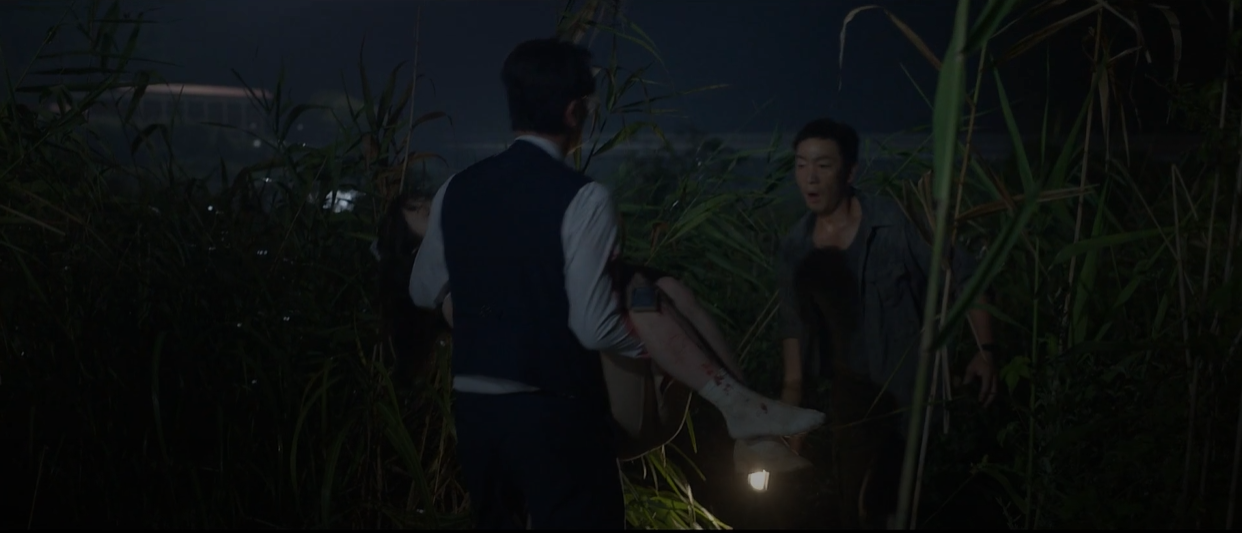
He finds her — but not quickly enough to stop what’s already begun. The killer has her. Si-young intervenes, physically, without backup, without hesitation.
The knife finds him before he can fully protect her.
He takes the blade. Soon-yeong survives.
Tae-joo arrives to find Si-young bleeding, holding his sister, having just done the one thing Tae-joo never expected from him: put someone else’s safety above his own.
As Si-young loses consciousness, something that has been locked inside him for thirty years finally comes out:
“I thought you were my father’s son. I can’t stand brothers. But a friend — that might have been different.”
He passes out before Tae-joo can respond.
In Korean there is a concept called han — a collective, generational grief, a sorrow that accumulates across decades and becomes part of a person’s identity without them choosing it. What Si-young carries about that childhood moment is han. What Tae-joo carries about everything Si-young did afterward is also han. Two people, shaped by the same wound, finally saying so out loud.
Thirty years too late. And not late enough.
Meanwhile — Another Victim
While all of this is unfolding, the killer — having failed to take Soon-yeong — doesn’t stop.
He breaks into a nearby house. He moves through the dark interior with practiced efficiency. At one point he presses his finger against the changho — the traditional Korean paper screen door — and punctures it to peer through at whoever is sleeping inside.
This detail is not accidental. Investigators of the real-life case this drama is based on described an almost identical scene from one of the Hwaseong murders: a killer who peered through punctured paper screens at sleeping women before entering. The drama is citing history. And the citation is terrifying.
Another victim is found. And somewhere in the overlapping timelines, Gi-beom’s flight path has crossed exactly with the crime scene’s window. He wasn’t there. But the evidence doesn’t know that yet.
2019: The Cost of Collaboration
The present-day frame closes the episode.
Tae-joo sits across from Lee Yong-woo in the prison visiting room. Yong-woo asks — with the unhurried curiosity of a man who has been watching Tae-joo’s life from a distance for three decades — what it did to him, working with the man he hated most.
Tae-joo’s answer is four words:
“The bad side. Everything.”
He lost everything. Whatever he gained from the partnership — justice, partial answers, forward momentum — it cost him everything he had outside the case.
The episode ends on that admission. Not with an explosion or a revelation, but with a man in a visiting room telling the truth about what thirty years of this story actually cost him.
Verdict: The Drama That Keeps Getting Deeper
The Scarecrow has now done something very few Korean crime dramas manage: it has made us genuinely uncertain about its own villain. Four episodes in, and the question isn’t just who is the scarecrow — it’s how many of these people have been shaped by the same damage?
The revelation of Si-young’s backstory reframes everything. He isn’t a simple antagonist operating from ambition and cruelty. He is someone who watched his family shatter and responded the only way his damaged adolescent logic could construct. That doesn’t excuse what he did. But it makes him real in a way that simple villainy never could.
The handkerchief evidence is the episode’s most elegantly constructed trap — for the audience as much as for Gi-beom. We’ve been watching him suspiciously since Episode 1. The drama has been planting seeds. Now it’s offering us the harvest, and the feeling isn’t relief. It’s unease. Because The Scarecrow has taught us by now that the obvious answer is usually the wrong one.
The scarecrow stands in the field and lets people’s eyes slide off it. The drama is doing exactly the same thing. And we keep falling for it.
Where to Watch: Viu & Viki (International)
Total Episodes: 12 | Airs: Monday & Tuesday at 10PM KST on ENA
Our Verdict: 🌾🌾🌾🌾🌾 — Four episodes in and The Scarecrow is operating at a level most dramas never reach at all.
→ Next: Episode 5 Recap — Gi-beom is in custody. The evidence points one way. But the killer is still out there. And someone very close to the truth is about to make the most dangerous mistake of the investigation.
All promotional images and stills © ENA / Studio Genie / TVING.
Thumbnail image via Viu.
Used for review and commentary purposes only.
No copyright infringement intended.
All rights reserved to their respective owners.