Perfect Crown Episode 12 Finale Recap: A King Who Ends the Monarchy, a Villain Who Blames the Wrong Person, and the Name He Always Wanted to Hear
 Perfect Crown — Episode 12 Finale Recap: “Wan.”
Drama: Perfect Crown (21세기 대군부인)
Network: MBC
Streaming: Disney+ (International)
Air Date: May 16, 2026
Cast: IU (Seong Hee-ju), Byeon Woo-seok (Grand Prince Lee Wan), Gong Seung-yeon (Yoon Yi-rang), Noh Sang-hyun (Min Jung-woo), Yoo Soo-bin (Choi Hyeon), Kim Eun-ho (King Lee Yoon)
“I thought your dream was treason. Turns out it was revolution.” — Seong Hee-ju, Episode 12
The night before his coronation, Lee Wan tells Hee-ju what his first act as king will be. She laughs. She says she thought he was planning a coup. Then she calls it what it actually is: a revolution. He asks if she is ready to give up the title she spent the entire series pursuing. She says she never wanted the title — she wanted the opportunities the title had denied her. If the title itself disappears, those denials disappear with it.
This is the conversation that frames everything that follows. Perfect Crown began with a woman proposing marriage to a prince for social advancement. It ends with the same woman watching the social structure she married into vote itself out of existence, then stepping outside a palace gate to call the former king by his first name. Thirteen-point-eight percent nationwide. Fourteen-point-one in Seoul. The series’ highest number on its last night. The third-highest-rated MBC Friday-Saturday drama in the network’s history.
The finale earned every one of those viewers. Mostly.
The First Act of a King — and the Room That Cannot Believe It
Lee Wan convenes the royal clan and the full cabinet and places the question of monarchy abolition on the table as his opening agenda. Not after settling in. Not after establishing authority. First thing, first day.
The room’s response is what you would expect from a room full of people whose identity and income are structurally dependent on the institution he is proposing to eliminate. Min Jung-woo leads the opposition with the language of national stability and cultural heritage. The clan elders translate their panic into procedural objection. Lee Wan listens and then asks the question that strips all the procedural language away: what they are actually defending is the right to be born into privilege, and they know it, and he is not going to pretend otherwise.
He proposes a national referendum. The decision belongs to the people. If the people want the monarchy, it stays. If they do not, it ends. The room cannot object to this without explicitly arguing against democratic process, which none of them are willing to do on record. The referendum is authorized.
Min Jung-woo’s Last Moves — and Why They All Fail
He cuts the royal budget. Hee-ju responds the same day by having Castle Group donate more than a full year’s operating costs to the palace. He targets Castle Group with a financial investigation, framing it as a corruption probe. Tae-ju, in what has become his signature contribution to this series, shows up to the investigation himself — his wife is pregnant, he has nothing left to protect with caution — and the family’s legal team begins building a counter-narrative around prosecutorial overreach rather than financial misconduct.
Min Jung-woo tries Yi-rang next. He puts her in a car and delivers his terms: appear at the abolition debate and signal that the king is acting unilaterally, without consensus. If she refuses, he will use the suppressed royal edict from three years ago to make her son a historical criminal. He delivers this with the confidence of a man who has been running the board for twelve episodes and has not yet encountered a move he could not counter.
He has not, until now, understood who Yi-rang has become.
Yi-rang’s Recording — and the Weapon She Hands to Hee-ju
Hee-ju goes to see Yi-rang. She does not go to threaten or to negotiate. She goes to ask for help, directly, and Yi-rang responds with the question she has been sitting with since Lee Wan declined to punish her: why has he let her remain unpunished? Hee-ju’s answer is not flattering and is completely accurate. She tells Yi-rang that the most painful thing Min Jung-woo can experience is to be exposed by Hee-ju specifically — because he loved her, and because being taken down by the person you loved and never had is a more precise injury than anything else available.
Yi-rang listens. Then she plays her the recording.
The audio contains Min Jung-woo confirming, in his own voice, that he would kill the king again if necessary. Yi-rang recorded the conversation in the car. She has been holding it since. She hands it to Hee-ju now, with one additional observation: the version she has edited removes the portions that implicate herself in the previous king’s testament. It is not a full confession. It is a surgical instrument, calibrated for maximum damage to one specific target.
“He should be cut by your hand,” Yi-rang says. “That will hurt him most.”
The Council Chamber — and the End of Min Jung-woo
The abolition debate reconvenes. Min Jung-woo is mid-argument — the monarchy as cultural anchor, the monarchy as institutional stability — when Hee-ju walks into a room she has no formal right to enter and asks him, in front of everyone, whether he tried to kill the king in order to stop the monarchy from being abolished.
She plays the recording.
The room goes silent with the particular silence that falls when evidence is so clear that even the people who might have wanted to help cannot find the vocabulary. Min Jung-woo looks at her. He does not answer immediately. Lee Wan asks him directly: is it true? Min Jung-woo cannot deny the audio. He cannot deny the voice. What he does instead — and it is the most revealing thing the show has ever had him do — is attempt to distribute the blame.
He says Lee Wan caused this. He says if Lee Wan had simply sent Hee-ju away when asked, none of it would have happened.
Lee Wan’s response is the episode’s best line, delivered without heat: you cannot lose something you never had. Min Jung-woo spent years believing Hee-ju was taken from him. She was never his to take. The error in the accounting was his, and the bill is his to pay.
He leaves Min Jung-woo standing in the room with the recording playing and walks out. Min Jung-woo, for the first time in twelve episodes, has nothing to do with his hands.
What Lee Wan Actually Wanted
After the council chamber, Lee Wan finds Hee-ju. She holds him while he processes the fact that the person he trusted longest has just confirmed, in his own voice, that he tried to have him killed. He does not perform this grief. He is simply present in it, and she is present with him, and the scene does not require music or camera movement to land.
Later, he tells her what he wants if the referendum succeeds. Not political. Not structural. He wants someone to call him by his name. He has been Grand Prince, Your Highness, Your Majesty, regent, and several things that cannot be printed. He has not, in any official context, been Wan. She points out, correctly, that she called him that once — in the council hall fire, when she was running toward him through the smoke. He accepts this correction. He still wants to hear it again, properly, from outside a burning building.
The Vote — and the Last Royal Act
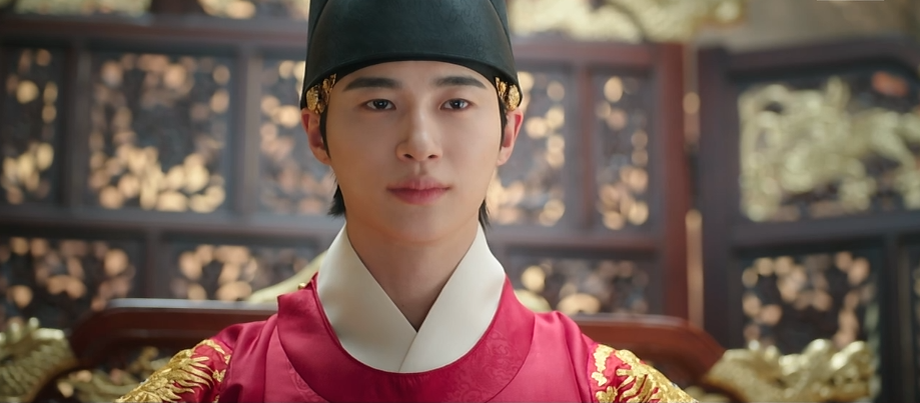
The national referendum runs. The result comes back. The people have spoken, and what they have said is: the monarchy ends. Lee Wan, exercising the final constitutional authority of the throne, declares the completion of the monarchical system. The 34th and last king of the constitutional monarchy, posthumous title Seongio, steps away from the seat he spent the entire series approaching and five minutes occupying in its final form.
He walks out of the palace gate.
Hee-ju is standing outside. She sees him emerge in civilian clothes and calls his name across the distance between them. Not a title. Not a form of address. His name: Wan. He smiles — the wide, unmanaged kind that only appears in this series when no one is watching and then immediately when she calls him anything at all — and runs to her. She takes his hand. They walk away from the palace together.
The gate closes behind them.
Three Years Later — Ordinary Life, Earned
The epilogue gives the show room to breathe that the previous eleven episodes rarely allowed. Hee-ju is back at Castle Beauty, sorting through the decisions Tae-ju made in her absence with the expression of someone who expected this and is still annoyed. Tae-ju arrives to inform her that his wife is pregnant,육아휴직 has been invoked, and Castle Card needs someone competent. She calls him a lunatic. He leaves smiling. She picks up the file.
Lee Wan, now simply Wan, is in a kitchen with Choi Hyeon. They are cooking. The dish is not edible. Hee-ju texts that she is working late. He and Choi Hyeon sit with their failed dinner and discuss the situation. Choi Hyeon mentions that Hee-ju has no wedding ring. He suggests a re-proposal. Lee Wan’s ears visibly perk up.
Seong Hyeon-guk visits Hee-ju at the office late in the evening. He tells her, for the first time without qualification, to go prove herself. He says he never wanted her to lose. He wanted her not to have to fight so hard. He is saying this twelve years late and both of them know it. She cries. The scene is the quietest in the finale and the one that will land differently on a rewatch than it does the first time.
Yi-rang is at a violin shop with the former King Lee Yoon, now a regular student with a math tutor and a violin lesson. Lee Wan pays for the instrument without being asked. They make plans to share a meal. Yi-rang calls him “my brother-in-law” as he leaves. He tells her to take care. They are two people who have survived something enormous and are managing the aftermath with the careful courtesy of people who are not yet sure what they are to each other but are trying to find out.
Choi Hyeon and Do Hye-jeong have rings that match. They hold hands in front of everyone. Nobody looks surprised. Everybody looks pleased.
The Re-Proposal That Goes Wrong in the Right Way
Lee Wan prepares a second proposal. He has flowers. He has a ring. He has a speech. Hee-ju walks in while he is mid-rehearsal and sees all of it. She says: why are you doing this again? He says: because the first time was under duress. She says: I fell asleep in the middle of the first proposal too, you know. He looks devastated in exactly the way of someone who has been planning something for three weeks and has just been told the punchline arrived before the setup.
She relents. They sit together. She tells him when she first liked him: the moment she saw him with the ceremonial fan at the Royal Academy tournament, managing to look both ridiculous and magnetic simultaneously. He tells her when he first liked her: when she told him her name for the first time and he could not stop thinking about it afterward. He says by the time the Tanil-yeon banquet came around and she walked in wearing red, he was already running to get there before she left.
She kisses him before he finishes the sentence. He kisses her back. The re-proposal is technically incomplete. Neither of them cares.
The Museum — and the Last Name on the Wall
Lee Wan visits the museum that now houses the palace artifacts. His ceremonial robes are on display. The placard reads: the 34th and final king of the constitutional monarchy of Korea, Seongio. He stands in front of it for a long moment and says, to no one in particular, that it was not his when he wanted it, and was his when he did not want it, but at the end it was his choice. He finds this adequate. He leaves.
The Baseball Stadium — and the Kiss They Did Not Get to Have Before
The four of them — Lee Wan and Hee-ju, Choi Hyeon and Do Hye-jeong — go to a baseball game. Castle Sharks. Uniforms. The full experience Lee Wan was never able to have while royal protocol applied to him. He wears the jersey without hesitation. He eats whatever he wants. He cheers without modulating the volume for dignity.
The kiss-cam finds them. It has found them before. The last time, Hee-ju held up her phone with a message about royal decorum and the moment dissolved into laughter. This time there is no decorum to protect. Lee Wan turns to her. She turns to him. The crowd cheers. They kiss — properly, without strategy, without an audience to perform for even while an audience is watching — and the series ends on that image.
The show that opened with a proposal delivered across a formal table closes with a kiss in the bleachers. The distance between those two images is the entire story.
A Note on What the Finale Does Not Resolve
Some threads were left open. The marriage contract leak was never formally attributed to Min Jung-woo with the same evidentiary clarity as the assassination attempts. The spy Seong Hyeon-guk mentioned placing in the palace was never identified. The precise mechanics of what a post-monarchical Korean government looks like were not dramatized. Min Jung-woo’s final legal fate was not shown. Some viewers found these omissions significant. They are worth naming, because a drama that sold itself on political complexity owed its more invested viewers more closure on the political threads it opened.
The emotional threads, by contrast, were tied with care and, in several cases, real grace. The show understood that its center was always the question of what two people owe each other when the arrangement they made stops being the point — and it answered that question cleanly, warmly, and in a baseball stadium, which is exactly where an answer like that belongs.
Series Verdict
Perfect Crown was a show of considerable strengths and acknowledged limitations. Its production design was exceptional. Its premise was inventive. Its supporting cast — Gong Seung-yeon in particular — delivered performances that elevated every scene they occupied. Its central romance worked because the show committed to building it properly rather than rushing it, and because both leads found specific, earned ways into characters who could have been types and became people instead.
What it struggled with was the same thing many high-concept romantic comedies struggle with: the machinery of the political plot sometimes ground against the grain of the emotional story, and the finale’s decision to resolve everything quickly in order to reach the epilogue left some of the series’ more ambitious threads without proper closure. The historical accuracy controversy — the crown, the acclamation, the public apology — became part of the drama’s cultural story in a way its creators did not intend and would not have chosen.
And yet. A show that started at 7.8% and finished at 13.8%. Disney+’s most-watched Korean drama globally. Six weeks of sustained national conversation. A scene in which a man who was born a prince walks out of a palace gate and hears his name called by a woman who came there to marry him for his title and stayed because she could not imagine him without it. MBC’s third-highest-rated Friday-Saturday drama in history.
The crown it earned was imperfect and entirely its own. So was the one it abolished.
Where to Watch: Disney+ (International)
Total Episodes: 12 | Aired: April 10 – May 16, 2026 on MBC
Series Verdict: ⚾👑💕 — Imperfect, ambitious, and genuinely felt. The baseball stadium ending is the right ending. “Wan.” is the right word. Recommended.
Thank you for watching with us. Perfect Crown ran for six weeks and left its mark. The KBINGETIME series coverage ends here — until the next one.
All promotional images and stills © MBC / Kakao Entertainment / Disney+. Used for review and commentary purposes only. No copyright infringement intended. All rights reserved to their respective owners.